

The Expensive Mistakes Usually Happen Before Development Starts#
Building a SaaS product is expensive.
Rebuilding one because the original technical decisions were wrong is even more expensive.
A founder can have a strong idea, hire a development team, and successfully launch a product only to discover a few months later that every new feature is becoming slower, more expensive, and riskier to build.
People often blame bad code.
But the real problem may have started before the first line of code was written.
The product may have been overbuilt. The architecture may have been unnecessarily complex. Important decisions about data, integrations, subscriptions, security, or long-term maintenance may have been postponed.
You do not need to predict the future perfectly before building a SaaS product.
You simply need to make the right decisions deliberately instead of discovering them after you have already invested heavily.
Here are 10 decisions worth thinking through before development starts.
1. Are You Building an MVP or a Full Product?#
Many projects become expensive because everyone says they are building an MVP but nobody defines what that means.
An MVP should validate an important business assumption.
For example:
Will property managers pay for a platform that automates maintenance requests?
The first version probably does not need:
- advanced analytics
- multiple mobile apps
- complex reporting
- AI recommendations
- ten integrations
It needs enough functionality for a real customer to experience the core value.
Ask this question first#
What is the smallest version of this product that can deliver meaningful value to a real customer?
Separate your requirements into:
- Must-have for launch
- Important, but later
- Nice to have
- Assumptions that need validation
The goal is not to cut quality.
The goal is to avoid paying for features before you know customers need them.
2. What Should You Build vs Integrate?#
Not every feature should be custom-built.
Your product may need:
- authentication
- payments
- file storage
- analytics
- scheduling
- AI capabilities
The question should not always be:
How do we build this?
Ask instead:
Is this part of our competitive advantage?
If the answer is no, an existing service or API may be a better option.
Build custom functionality when:#
- it is central to your product
- it creates meaningful differentiation
- existing tools cannot support your workflow
Use existing tools when:#
- the problem is already well solved
- building it creates unnecessary risk
- it would slow down your launch
Your development budget should primarily go toward what makes your product valuable not rebuilding infrastructure that already exists.
3. How Complex Should the Architecture Be?#
Founders often hear about:
- microservices
- serverless architecture
- event-driven systems
- distributed systems
These approaches can be useful.
They can also introduce significant complexity.
| Approach | Best For | Main Trade-Off |
|---|---|---|
| Simple application | Early products | Can become messy without structure |
| Modular application | Growing products | Requires good boundaries |
| Microservices | Specific large-scale needs | Higher operational complexity |
The right question is not:
What architecture will support millions of users?
It is:
What is the simplest architecture that can solve today's problem and evolve tomorrow?
A system does not become scalable simply because it has more services.
Start with appropriate complexity. Add complexity when there is a real reason to do so.
4. What Data Decisions Will Be Difficult to Change Later?#
Features can often be changed quickly.
Data becomes harder to change once real customers depend on it.
Think early about:
- customer data separation
- user roles and permissions
- reporting requirements
- audit history
- ownership of data
For example: Multi-tenancy#
If multiple businesses will use your SaaS, ask:
- How will each customer's data be separated?
- Can users ever access another company's data?
- How will permissions work?
- What happens as an organization adds more users?
You do not need to predict every future feature.
But you should identify the data decisions that could become expensive once your product is live.
5. What Should You Build Now and What Can Wait?#
Every feature has more than a development cost.
It also creates:
- testing costs
- maintenance costs
- support costs
- future modification costs
And there is one more cost founders often overlook:
Opportunity cost.
Every week spent building an MVP is a week not spent learning whether customers actually want the product.
Before prioritizing a feature, ask:
- Does the core product work without it?
- Will customers refuse to use the product without it?
- Can we initially handle this process manually?
- Does it validate our most important business assumption?
Build the workflow that proves your business model first.
Everything else can compete for a place on the roadmap later.
6. How Will Payments and Subscriptions Actually Work?#
A subscription is not just a payment button.
It affects:
- account access
- feature availability
- upgrades and downgrades
- failed payments
- cancellations
- customer communication
Think through the basic lifecycle early:
Customer subscribes
        v
Payment succeeds
        v
Account is activated
        v
Features become available
And also:
Payment fails
        v
Subscription status changes
        v
Customer is notified
        v
Retry or access rules are applied
You do not need every billing scenario on day one.
But you should avoid building your application in a way that makes subscription management painful later.
7. What Happens When External API Fails?#
Most SaaS products rely on external services.
These may include:
- payment providers
- CRM systems
- Google services
- AI providers
- shipping companies
- communication platforms
Your application may work perfectly while an external API does not.
A third-party service can:
- become unavailable
- respond slowly
- change its API
- enforce rate limits
- return incomplete data
Plan for:
- retries
- error handling
- logging
- webhooks
- background processing
The important principle is simple:
An external service is part of your workflow, but it is not under your control.
Design accordingly.
8. What Happens When the Product Starts Growing?#
You do not need to build for millions of users before you have your first customers.
But you should avoid creating problems that make normal growth unnecessarily expensive.
As your SaaS grows, you may encounter:
- larger databases
- slower queries
- more background jobs
- higher API usage
- increased storage needs
The best approach is usually:
- Launch with practical infrastructure.
- Monitor how the application behaves.
- Identify real bottlenecks.
- Improve the bottleneck.
- Repeat as the product grows.
Do not spend heavily solving problems you do not have yet.
But make sure you can identify problems when they arrive.
9. How Will You Protect Customer Data?#
Security should not be treated as something added before launch.
It affects how the product is designed.
Think about:
- authentication
- user permissions
- customer data separation
- backups
- audit history
- logging
Ask simple questions:
Who can access what?
What happens if data is accidentally deleted?
Can one customer ever see another customer's information?
These questions become much harder and more expensive to solve after the application is already serving customers.
10. Who Will Maintain the Product After Launch?#
Launching your SaaS is not the end of development.
After launch, you will still need:
- bug fixes
- new features
- dependency updates
- infrastructure maintenance
- performance improvements
- security updates
- integration changes
This is why the initial development cost is only part of the real investment.
Ask this question before you start#
Can another experienced developer understand and safely continue building this product six months from now?
A product becomes expensive to maintain when:
- the code is difficult to understand
- there is no documentation
- deployments are manual
- every change introduces new bugs
- knowledge exists only with one developer
Good engineering is not just about making software work today.
It is about making future changes manageable.
A Quick Checklist Before You Start Building#
Before investing in development, make sure you can answer these questions:
Product#
- What problem are we solving?
- Who is the first customer?
- What is the core value?
MVP#
- What is the smallest version that provides real value?
- Which features are required for launch?
- What can wait?
Technology#
- What should be built?
- What should be integrated?
- How simple can the architecture remain?
Data#
- How will customer data be separated?
- How will permissions work?
- Do we need audit history?
Growth#
- What will we monitor?
- How will we identify bottlenecks?
- What happens when demand increases?
Maintenance#
- Who will maintain the product?
- Can another developer take over?
- Is the system understandable and documented?
You do not need perfect answers to every question.
But asking them before development begins is far cheaper than answering them after a rebuild becomes necessary.
Build the Right Foundation Not the Biggest System#
The goal of a new SaaS product is not to build the most complicated system possible.
It is to build the right system for the current stage of your business.
That means:
- validating the right problem
- keeping the first version focused
- avoiding unnecessary complexity
- using existing tools where appropriate
- designing critical workflows carefully
- planning for change
- scaling based on evidence
Customers do not care whether your application uses the latest architecture pattern.
They care whether it:
- solves their problem
- works reliably
- protects their data
- continues improving over time
That is what your technical decisions should support.
Before development starts, take the time to ask the difficult questions.
It is almost always cheaper to make a good decision before development than to pay for the same decision again during a rewrite.
If you're planning a SaaS product, explore my portfolio to see the types of SaaS platforms, AI-powered systems, API integrations, subscription workflows, and web applications I've worked on.
Share this technical insight with your network
Share to LinkedIn or Facebook with key takeaways, featured media, and direct links.
Case Study: Building Imperial Votes: A Multi-Tenant Next.js & Prisma Competition Operating System
Imperial Votes is a custom online voting platform for beauty pageants, modeling competitions, and organizer-led public contests. I built the product from scratch, starting from a blank Next.js application and turning it into a full SaaS-style platform with public competition pages, contestant profiles, paid voting, leaderboards, organizer dashboards, super-admin controls, role-based permissions, contestant applications, entry fee payments, judging workflows, branding tools, analytics, reports, notifications, and leaderboard graphic generation. The basic product idea was simple: organizers create competitions, contestants compete, voters buy vote bundles, and the leaderboard updates. The actual product became much bigger than that. Imperial Votes needed to support real organizers, real money, real applicants, different countries and currencies, different payment gateways, sponsor visibility, custom competition branding, membership tiers, internal admin workflows, and marketing tools that help organizers promote their contests. My work covered the entire platform: database architecture, backend APIs, payment logic, frontend dashboards, public pages, security and permissions, operational tooling, reporting, exports, image handling, email flows, real-time notifications, and polished UI features such as canvas-based leaderboard graphics.
Related Technical Articles
View all articles →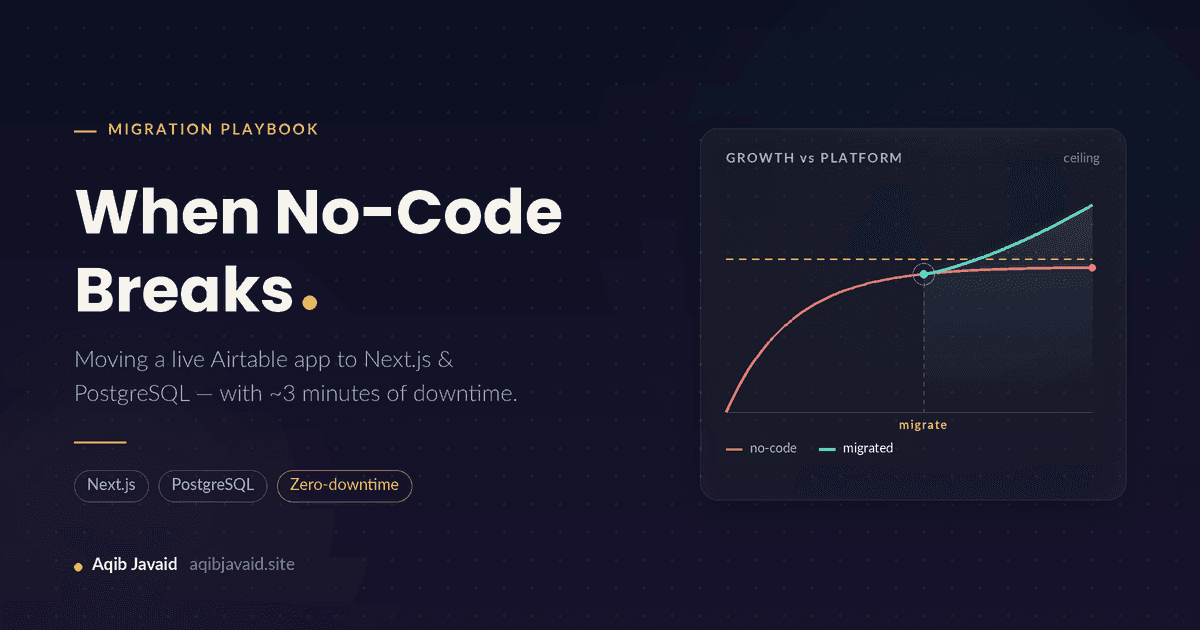
When No-Code Breaks: Migrating a Live Airtable App to Next.js & PostgreSQL Without Losing Users
No-code apps rarely die, they plateau: row ceilings, 8-second loads, a $700 monthly bill. Here is how to move a live one to Next.js and PostgreSQL safely.
Building AI Features in Laravel Without Turning Your Application Into a Mess
AI features can quickly turn a clean Laravel application into a maintenance nightmare. Here's how to integrate AI without sacrificing architecture.
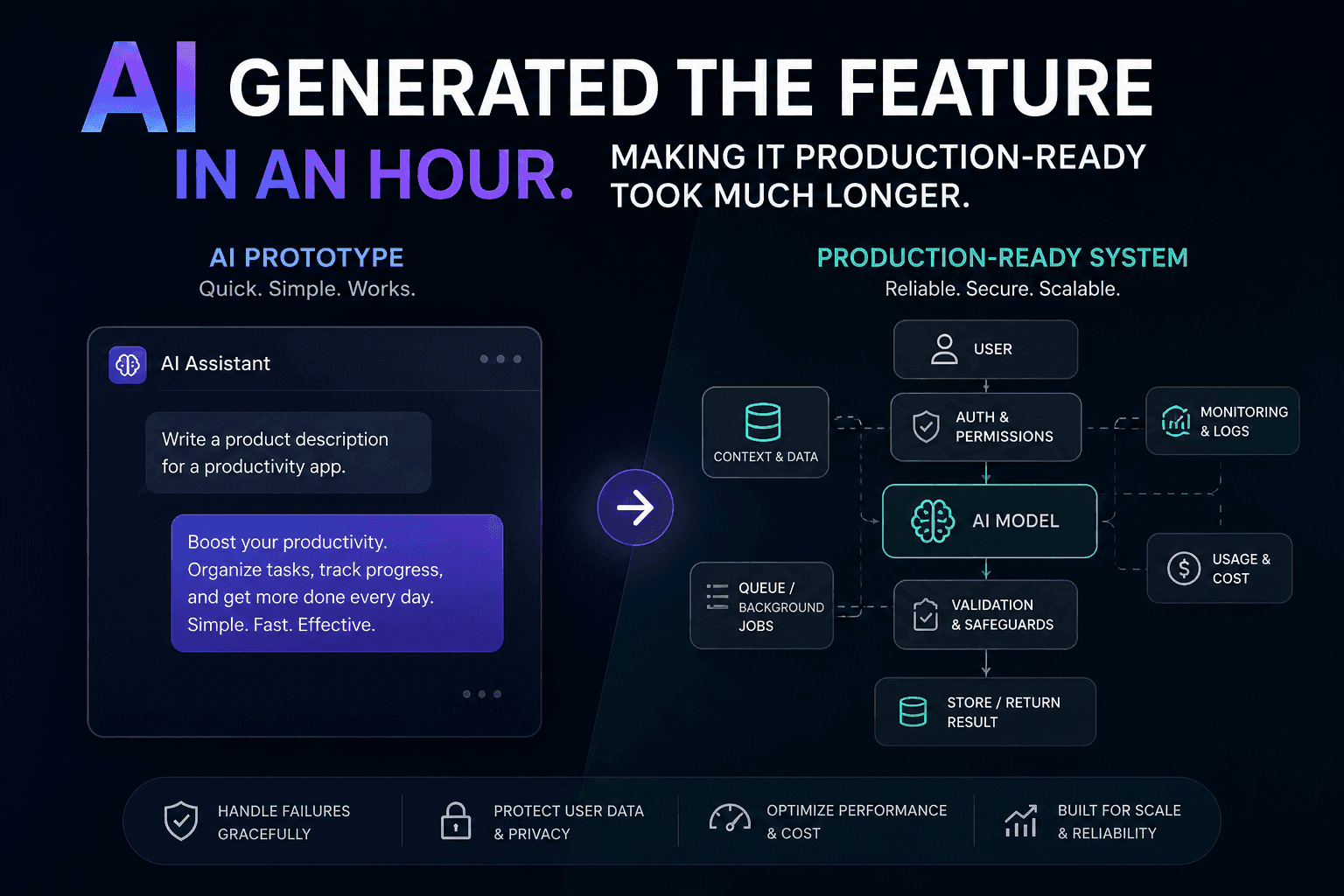
AI Generated the Feature in an Hour. Making It Production-Ready Took Much Longer
AI can generate a feature quickly, but a working demo is not a production-ready system. Here is how I approach closing that gap.
Have a complex technical project in mind?
Available for full-stack engineering, performance audits, cloud deployments, and high-concurrency systems architecture.