

Choosing the Right Web Development Framework in 2026#
Modern web applications can be built with dozens of frameworks, runtimes, and architectural approaches. The difficult part is rarely finding a framework that can build the application. The real challenge is choosing one that fits the product's requirements, team capabilities, deployment model, and expected growth.
For a small marketing website, a full-stack application, a real-time platform, or a high-traffic SaaS product, the best framework can be very different.
This guide explains how to evaluate modern web development frameworks, when to choose popular options such as Next.js, Laravel, React, Vue, Nuxt, and Node.js, and how to make the decision based on engineering requirements rather than trends.
What Makes a Good Web Development Framework?#
A framework should reduce engineering complexity rather than simply provide a large collection of features.
When evaluating a framework, I usually look at several factors:
- Application architecture
- Rendering strategy
- Performance characteristics
- Developer experience
- Database and API integration
- Authentication and authorization
- Deployment requirements
- Ecosystem maturity
- Long-term maintainability
- Team familiarity
- Expected application scale
The most popular framework is not automatically the best choice.
A technically sophisticated application can still become difficult to maintain if its framework, architecture, and infrastructure do not match the actual requirements.
For professional web development services, framework selection should therefore happen after understanding the product rather than before.
Next.js for Modern Full-Stack Applications#
Next.js has become one of the strongest choices for modern React applications.
It combines React with application-level capabilities such as:
- Server-side rendering
- Static generation
- Server Components
- Route handlers
- Middleware
- Metadata APIs
- Image optimization
- Streaming
- Dynamic routing
- Server actions
This makes it particularly useful when the frontend and backend need to work closely together.
When Next.js Makes Sense#
Next.js is a strong choice for:
- SaaS applications
- Content-heavy websites
- Developer portfolios
- E-commerce applications
- Dashboards
- Marketing websites
- SEO-sensitive applications
- Full-stack React products
One of its biggest advantages is that rendering strategy can be selected per part of the application.
A page can be static where appropriate, dynamically rendered when necessary, and progressively enhanced with interactive React components.
When Next.js May Not Be the Best Choice#
Next.js is not automatically the right solution for every project.
A relatively simple application may not need the additional architectural complexity that comes with a full-stack React framework.
Similarly, if a team already has a mature backend platform built around another ecosystem, introducing Next.js purely because it is popular may create unnecessary complexity.
Framework selection should follow the application's requirements.
Laravel for Backend-Heavy Web Applications#
Laravel remains an excellent choice for applications where backend architecture, business rules, databases, queues, authentication, and APIs are central to the product.
Laravel provides a mature ecosystem around:
- Routing
- Authentication
- Authorization
- Database access
- Queues
- Events
- Notifications
- Scheduling
- API development
- Background jobs
- Testing
- Application structure
This makes it particularly effective for business applications where the backend contains significant domain logic.
When Laravel Is a Strong Choice#
Laravel works particularly well for:
- Business applications
- SaaS platforms
- Admin systems
- CRM systems
- ERP applications
- API platforms
- Subscription applications
- Data-heavy applications
- Internal tools
A Laravel backend can also serve a separate React, Next.js, Vue, or mobile application through an API.
For applications with complex business rules, this separation can provide a clean boundary between the frontend experience and backend domain logic.
React Is a UI Library, Not a Complete Application Architecture#
React is often compared directly with frameworks such as Laravel or Next.js, but the comparison is not quite equivalent.
React primarily provides the component model and rendering approach for building user interfaces.
A production application normally requires additional decisions around:
- Routing
- Data fetching
- Authentication
- State management
- API communication
- Rendering
- Testing
- Deployment
This is why React is frequently paired with a framework such as Next.js.
The distinction is important when evaluating architecture.
Choosing React does not necessarily mean choosing the complete application architecture.
Vue and Nuxt#
Vue provides another mature approach to component-based frontend development.
Its API and developer experience can be particularly attractive for teams that prefer a more structured frontend development model.
For applications requiring server-side rendering, routing, SEO support, and application-level conventions, Nuxt provides a framework around Vue.
When Vue or Nuxt Makes Sense#
Vue and Nuxt can be excellent choices for:
- Content-driven websites
- SaaS interfaces
- Dashboards
- E-commerce applications
- Marketing websites
- Full-stack JavaScript applications
The decision between React/Next.js and Vue/Nuxt should generally be based on team expertise, ecosystem requirements, existing codebases, and product needs rather than benchmark comparisons alone.
Node.js for API and Real-Time Applications#
Node.js is particularly useful when JavaScript or TypeScript needs to run on the server.
Its asynchronous I/O model makes it well suited to workloads involving many concurrent network operations.
Common use cases include:
- REST APIs
- GraphQL APIs
- Real-time applications
- WebSocket services
- Notification systems
- Integration services
- Background workers
- Microservices
Node.js is especially useful when an application needs to communicate with many external services or maintain long-lived connections.
For larger applications, frameworks such as NestJS can provide additional architectural structure around Node.js and TypeScript.
How to Choose Between Next.js, Laravel, and Node.js#
There is no universal winner.
The better question is:
Which technology provides the simplest maintainable architecture for the application's actual requirements?
A simplified decision model looks like this:
| Requirement | Strong Candidate |
|---|---|
| SEO-focused React application | Next.js |
| Full-stack React application | Next.js |
| Complex business backend | Laravel |
| API-heavy PHP application | Laravel |
| Real-time JavaScript services | Node.js |
| TypeScript backend | Node.js / NestJS |
| Vue-based application | Nuxt |
| Large existing Laravel application | Laravel |
| Large existing React application | Next.js / React |
These are starting points rather than hard rules.
Architecture should always account for the existing codebase, team expertise, deployment environment, database, integrations, and long-term maintenance requirements.
Framework Selection Should Start With Requirements#
A common mistake is starting a project with:
"Which framework is best?"
A better question is:
"What does this application need to do?"
Before selecting a framework, define:
1. Application Type#
Is it:
- A marketing website?
- SaaS platform?
- E-commerce application?
- Internal dashboard?
- Marketplace?
- API platform?
- Real-time application?
Different application types create different technical requirements.
2. Rendering Requirements#
Determine whether the application needs:
- Client-side rendering
- Server-side rendering
- Static generation
- Incremental regeneration
- Streaming
- Hybrid rendering
SEO-sensitive pages often benefit from server-rendered or statically generated HTML, while highly interactive authenticated dashboards may rely more heavily on client-side rendering.
3. Backend Complexity#
Ask how complicated the business logic will become.
A simple CRUD application and a multi-tenant platform with subscriptions, permissions, workflows, integrations, queues, and audit logs have very different backend requirements.
4. Data Requirements#
Consider:
- PostgreSQL
- MySQL
- MongoDB
- Redis
- Search engines
- External APIs
- Event streams
- File storage
The framework should integrate cleanly with the application's data architecture.
5. Deployment#
The deployment environment matters too.
Consider whether the application will run on:
- VPS infrastructure
- Docker
- Kubernetes
- Serverless infrastructure
- Managed cloud platforms
- Traditional hosting
A framework that works perfectly in development can become unnecessarily difficult to operate if its deployment model does not match the infrastructure.
Framework Performance Is More Than a Benchmark Score#
Framework comparisons often focus on benchmark numbers.
Real-world performance is more complicated.
Application performance depends on:
- Database queries
- Network latency
- API design
- Caching
- Rendering strategy
- JavaScript bundle size
- Image optimization
- Infrastructure
- Database indexes
- Background processing
- Third-party services
A poorly designed application can be slow regardless of whether it uses Next.js, Laravel, Vue, or Node.js.
Likewise, a well-designed application can perform extremely well on a wide range of technologies.
The framework is only one part of the performance equation.
For applications where database performance becomes important, I recommend treating database architecture and query optimization as first-class engineering concerns rather than trying to solve everything at the framework layer.
Monolith vs. Separate Frontend and Backend#
Framework selection also affects application architecture.
A traditional monolithic application may contain:
Browser
   v
Web Application
   v
Database
Share this technical insight with your network
Share to LinkedIn or Facebook with key takeaways, featured media, and direct links.
Related Technical Articles
View all articles →
Real-Time Features in Laravel SaaS: Architecting Broadcasting and WebSockets That Hold Up in Production
A live dashboard that works for one user in a demo is easy. One that works for 500 users across tenants, through a dropped connection, is the real engineering problem.
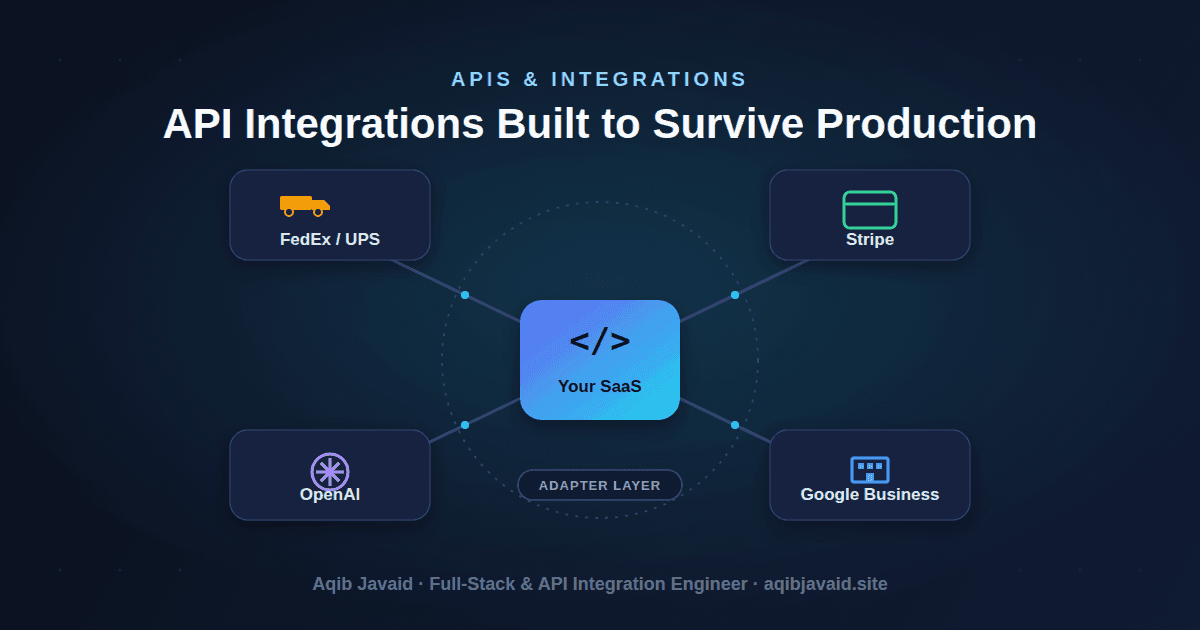
Third-Party API Integration Best Practices: Lessons From 8 Years in Production
Most API integrations don't fail on day one - they fail at 2am, six months later. Here's how to build ones that don't.
Have a complex technical project in mind?
Available for full-stack engineering, performance audits, cloud deployments, and high-concurrency systems architecture.