

If you are asking what mobile app development cost looks like for a real business app, the honest answer is a range, and the screens are rarely the expensive part. Most budgets are decided by what happens behind the screens: the API, payments, maps, push notifications and background features that make the app useful.
I build mobile apps with a Flutter front end and a Laravel backend, so this guide is the budgeting conversation I have with founders before any code is written. It covers what drives the price, three realistic scope tiers, where budgets go wrong, and how to cut cost without cutting the parts that matter. If you are still choosing a framework, start with my comparison of React Native vs Flutter for an MVP.
What actually drives mobile app development cost?#
Five things move the number far more than screen count does.
- Platforms. One cross-platform codebase (Flutter or React Native) for iOS and Android costs far less than two native apps. For most business apps, cross-platform is the right default.
- Number of user roles. A customer app plus a driver app plus an admin panel is three products, not one.
- Backend and integrations. Payments, maps, push notifications, third-party APIs and syncing with existing systems usually take more effort than the interface. My API integration cost and timeline guide breaks this down.
- Background and real-time features. Live GPS tracking, offline mode and real-time messaging need careful engineering and testing on real devices.
- Store requirements and polish. App Store and Google Play review, privacy declarations, accessibility and handling many device sizes all add work.
If you can only answer one question before asking for a quote, make it this: what does the app have to do when nobody is looking at the screen? Background location, scheduled sync and notifications are where estimates blow up.
Three realistic budget tiers#
These are indicative ballparks for a small senior team or a single senior engineer, not a quote. Your scope, integrations and design needs will move them.
| Tier | What you get | Typical range | Typical timeline |
|---|---|---|---|
| Simple MVP | One user role, 8 to 12 screens, login, basic API, push notifications | $8K to $20K | 6 to 10 weeks |
| Business app | Two roles, payments, maps, admin panel, a proper API, analytics | $20K to $60K | 3 to 5 months |
| Platform | Multiple apps, real-time tracking, dispatch or matching logic, third-party syncs | $60K+ | 5 to 9 months |
Two notes on reading the table. First, the backend and admin panel are included in each tier, because an app without them is a prototype. Second, agency pricing for the same scope is often higher because of account management, design and QA layers. That can be worth it for large programmes, and it is overkill for a focused MVP. My piece on why experience beats low-cost outsourcing covers the trade-off.
A real example: customer and driver apps on one Laravel API#
The clearest example of the "platform" tier in my own work is the ION DASH logistics and fleet platform. A legacy delivery application became a Flutter Customer app and a Flutter Driver app, both backed by one Laravel API.
The mobile screens were the visible part. The heavy lifting sat underneath:
- custom quotes and automated dispatch;
- background GPS tracking for drivers;
- delivery confirmation and proof of delivery;
- Stripe PaymentIntents and onsite billing;
- Firebase Cloud Messaging for push notifications;
- Google Maps navigation and catalog synchronisation.
That list is why a "delivery app" is a very different budget from a "catalogue app", even though both might have a similar number of screens. When you scope your own app, write the equivalent list first.
Advertisement
Why the backend decides the bill#
Founders often ask for a quote for "the app" and forget that someone has to build and run everything the app talks to. For a Flutter app I normally build a Laravel REST API using Sanctum for token authentication, with the business rules, payments and notifications living on the server. That keeps the app thin, which matters for three reasons:
- Updates without store review. Pricing rules, validation and workflows can change on the server without waiting for App Store approval.
- One source of truth. The customer app, driver app and admin panel all read the same data.
- Security. Secrets, payment logic and permissions never ship inside the app binary.
If you already have a backend, the budget shifts toward adapting it. If you do not, plan for roughly as much backend effort as front-end effort on anything beyond a simple MVP. My Laravel and PHP development service and mobile app development service pages show how I scope the two together.
// routes/api.php: one versioned API serves every client app
Route::prefix('v1')->middleware('auth:sanctum')->group(function () {
    Route::get('/orders', [OrderController::class, 'index']);
    Route::post('/orders/{order}/proof-of-delivery', [DeliveryController::class, 'confirm']);
    Route::post('/devices', [DeviceController::class, 'store']); // register push token
});
Where mobile budgets go wrong#
These are the patterns I see most often when I am brought in to rescue or re-estimate a project.
Scope that grows after the first quote#
"Add chat", "add a second user type" and "support tablets" each look small and each can add weeks. Agree a fixed first release and keep a written list for version two.
Underestimating store review and device testing#
Both stores have rules you must meet before launch, including privacy disclosures and payment policies. Read the App Store Review Guidelines early, and budget time for rejections and fixes.
Forgetting running costs#
The app is not finished at launch. Hosting, push notification volume, map API usage, crash monitoring, OS updates and bug fixes continue every year. A common rule of thumb is to plan around 15 to 20 percent of build cost per year, which I explain in software maintenance cost: what to budget each year.
Choosing native when cross-platform would do#
Separate native iOS and Android apps make sense for graphics-heavy or hardware-intensive products. For most business apps, Flutter delivers one codebase at a fraction of the price.
How to reduce cost without reducing quality#
- Launch one platform or one role first if your audience allows it, then expand.
- Cut features, not foundations. Skip social login and fancy animations before you skip a proper API and admin panel.
- Reuse proven services. Use Stripe for payments, Firebase Cloud Messaging for push and Google Maps for location rather than building them. The Firebase Cloud Messaging docs are a good example of a mature building block.
- Consider a web app first if you do not need device features like background location. A responsive web app can validate demand for much less. The SaaS MVP cost guide shows what that route looks like.
- Hire for judgement, not hourly rate. A senior engineer who removes a wrong feature from the plan saves more than a cheaper rate ever will.
Frequently asked questions#
How much does a simple mobile app cost?#
A simple cross-platform MVP with one user role, a handful of screens and a basic API typically lands between $8K and $20K. Anything involving payments, maps or an admin panel moves into the next tier.
Is Flutter cheaper than native development?#
Usually yes for business apps. One Flutter codebase covers iOS and Android, so you pay for design, development and testing once rather than twice. Native can still be right for very hardware-heavy apps.
How long does it take to build a mobile app?#
Expect 6 to 10 weeks for a simple MVP and 3 to 5 months for a business app with payments and an admin panel. Store review adds a few days to a couple of weeks.
Do I need a backend for my app?#
Almost always. Accounts, payments, notifications and data all live on a server. Even apps that look simple depend on an API.
Key takeaways#
- The backend, integrations and background features drive cost more than screen count.
- Budget in tiers: simple MVP, business app, then full platform, and say which tier you are in before asking for quotes.
- Cross-platform with Flutter is the right default for most business apps.
- Plan for ongoing costs of roughly 15 to 20 percent of the build per year.
- Write down what the app does when nobody is looking at the screen. That list is your real scope.
If you would like a realistic estimate for your own app, book a call and bring your feature list. I will tell you which tier it falls into and what to cut first.
Share this technical insight with your network
Share to LinkedIn or Facebook with key takeaways, featured media, and direct links.

About the author
Aqib Javaid
Senior Full-Stack Engineer
8+ years building Laravel, React/Next.js and AI-powered products for startups and growing businesses - SaaS platforms, APIs, integrations and the performance work that keeps them fast. Read the case studies to see how that plays out on real projects.
4.9 from 76 client reviews
Case Study: ION DASH - Logistics & Fleet Management Platform
ION DASH was transformed from a legacy delivery application into a modern logistics and fleet management platform combining Flutter Customer and Driver applications with a Laravel backend API. The platform handles custom quotes, automated dispatch, background GPS tracking, delivery confirmation, proof of delivery, Stripe PaymentIntents, Firebase Cloud Messaging, Google Maps navigation, onsite billing, and catalog synchronization.
Related Technical Articles
View all articles →
React Native vs Flutter for a Startup MVP: How to Choose
A founder-friendly comparison of React Native vs Flutter for an MVP: what each is, where each wins, what really drives cost, and a simple way to decide.
SaaS MVP Development Cost: What to Budget Before You Build
What goes into the cost of a SaaS MVP, which features quietly inflate it, and how to scope a first version that proves demand without burning your budget.
Custom API Integration Cost and Timeline: What to Expect
A plain breakdown of custom API integration cost and timeline: typical effort by complexity, what pushes the price up or down, and the questions to ask before you agree.
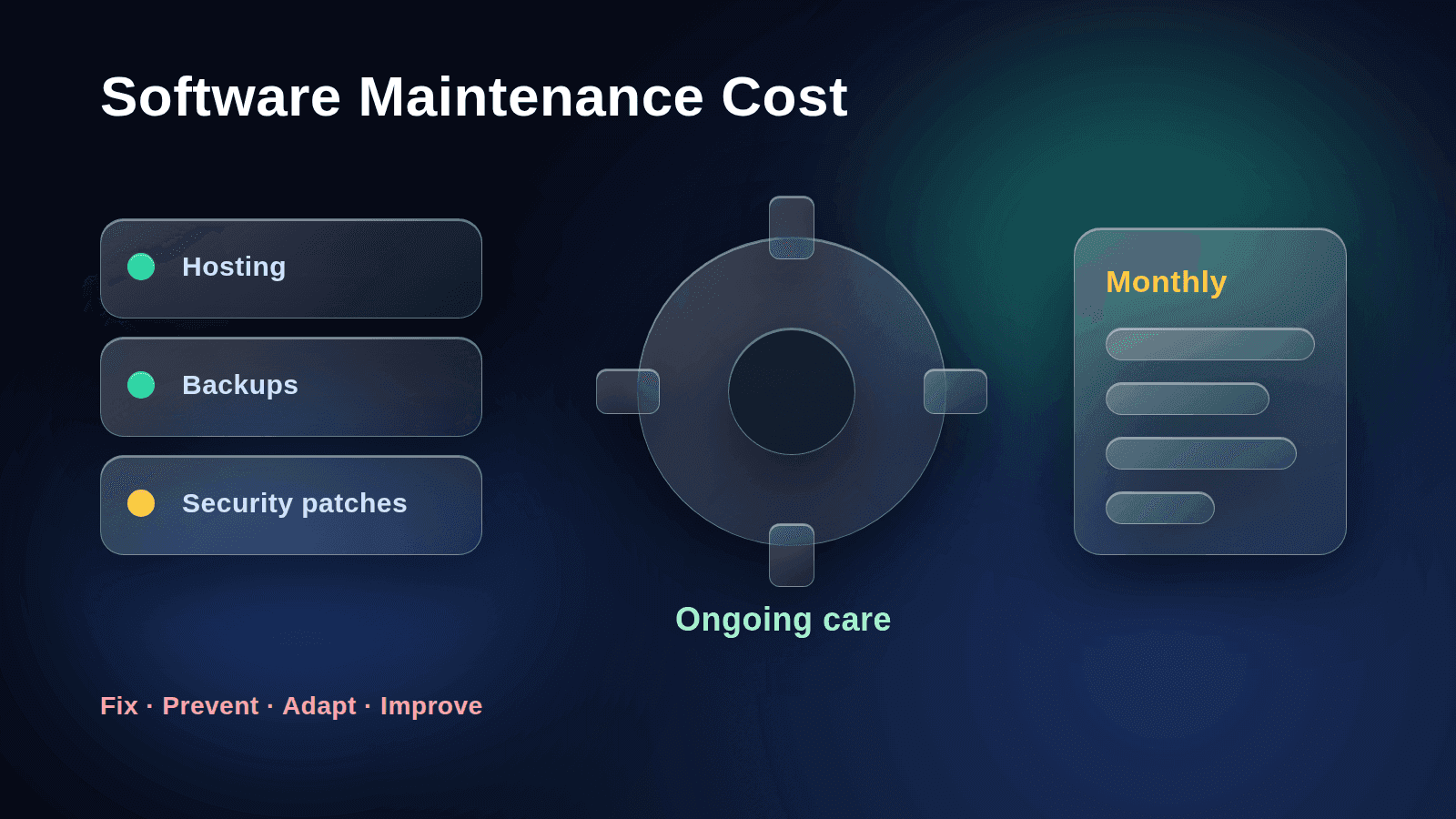
Software Maintenance Cost: What to Budget Each Year
What does software maintenance cost? See what it covers, the recurring costs people forget, how to choose a maintenance plan and how to estimate your own budget.
Have a complex technical project in mind?
Available for full-stack engineering, performance audits, cloud deployments, and high-concurrency systems architecture.