

Beyond the Basics: Why PHP Remains Essential for Modern Web Development#
PHP has an interesting place in modern web development.
It is one of the most established technologies on the web, yet it continues to evolve alongside newer programming languages, frameworks, cloud platforms, APIs, and development workflows.
Despite this, PHP is sometimes dismissed as an outdated technology.
That perception usually comes from associating modern PHP with the way PHP applications were commonly built many years ago. Procedural scripts, tightly coupled code, inconsistent architecture, and limited development tooling are not representative of how professional PHP applications are built today.
Modern PHP development can involve structured architectures, automated testing, REST APIs, queues, caching, containerization, CI/CD, cloud infrastructure, modern frontend frameworks, and sophisticated developer tooling.
Laravel has played an important role in that evolution, but the strength of PHP goes beyond any single framework.
Here is why PHP continues to matter.
PHP Has Evolved With Modern Web Development
One of the biggest misconceptions about PHP is that the language has remained unchanged.
It hasn't.
Modern PHP provides developers with a much more mature language and ecosystem than the PHP many developers remember from earlier web development.
Object-oriented programming, type declarations, namespaces, attributes, improved error handling, dependency management, Composer, modern testing tools, and powerful frameworks have transformed how PHP applications can be designed and maintained.
This means developers can build PHP applications using many of the same engineering principles expected from other modern backend ecosystems.
The difference is that PHP combines those capabilities with an enormous existing ecosystem and a very mature web-development footprint.
PHP Is Still a Strong Backend Technology#
Backend development remains one of PHP's strongest use cases.
A modern PHP backend can handle responsibilities such as:
- RESTful API development
- Authentication and authorization
- Database operations
- Business logic
- Background jobs
- Queue processing
- File management
- Payment integrations
- Third-party API integrations
- Email automation
- Administrative systems
- SaaS functionality
Frameworks such as Laravel provide developers with structured tools for many of these requirements.
For example, a Laravel application can combine routing, authentication, database abstraction, queues, events, notifications, scheduled tasks, API development, and testing into a cohesive development environment.
That can significantly reduce the amount of infrastructure developers need to build from scratch.
Laravel Has Changed How Developers Approach PHP#
When discussing modern PHP, it is difficult to ignore Laravel.
Laravel provides an expressive framework for building modern web applications while preserving the accessibility that makes PHP attractive to developers.
A Laravel application can serve as:
Backend API -> Database -> Queue -> External Services -> Frontend
That architecture can support everything from a small business application to a complex SaaS platform.
In my own work, PHP and Laravel have been central to backend systems, API integrations, SaaS products, business applications, and custom platforms. My experience includes Laravel-based systems alongside React, Vue.js, MySQL, PostgreSQL, Redis, APIs, and cloud infrastructure.
The important point is that Laravel doesn't make PHP relevant.
Rather, Laravel demonstrates how PHP has adapted to modern software engineering requirements.
PHP Is Particularly Strong for Ecommerce Development#
Ecommerce is another area where PHP continues to be highly relevant.
Platforms and ecosystems such as WordPress/WooCommerce provide businesses with a mature foundation for selling products online, while custom PHP and Laravel applications allow businesses to implement more specialized workflows.
A PHP-based ecommerce system can integrate:
- Payment gateways
- Product catalogs
- Inventory management
- Shipping APIs
- Customer accounts
- Order management
- Tax calculations
- Discounts and promotions
- Subscription billing
- Third-party services
This is particularly valuable when an ecommerce business moves beyond a standard storefront and begins requiring custom business logic.
My experience includes WordPress, WooCommerce, Shopify, custom themes and plugins, payment integrations, and ecommerce optimization.
That combination of mature platforms and flexible backend development is one reason PHP remains useful for businesses that need more than a basic online store.
PHP Works Well With Modern Frontend Technologies#
Another misconception is that choosing PHP means building the entire application with traditional server-rendered pages.
That isn't necessarily the case.
Modern PHP applications can work as backend services while React, Vue, Next.js, or other frontend technologies handle the user interface.
A typical architecture might look like:
React / Vue / Next.js -> REST API -> Laravel -> PostgreSQL/MySQL -> Redis
This separation allows frontend and backend teams to work independently while communicating through well-defined APIs.
I've worked across PHP/Laravel backend systems and frontend technologies including React.js, Vue.js, Nuxt.js, and Next.js.
That experience reinforces an important point: PHP doesn't have to compete with modern frontend frameworks.
It can power them.
PHP Is Well Suited to API-Driven Applications#
Modern applications increasingly depend on APIs.
Mobile applications, SaaS products, third-party integrations, internal dashboards, automation systems, and frontend applications often communicate with backend systems through APIs.
PHP is capable of handling these architectures effectively.
A Laravel backend, for example, can provide APIs consumed by:
- React applications
- Vue applications
- Mobile applications
- Third-party services
- Internal business tools
- Automation platforms
- External integrations
I've worked on RESTful APIs and integrations involving services such as Google authentication, Facebook authentication, shipping providers, business platforms, and AI services.
This makes PHP a practical choice for organizations that need a reliable backend rather than a technology chosen simply because it is fashionable.
Modern PHP Development Is About Engineering Practices#
The biggest difference between old and modern PHP isn't simply syntax.
It's how applications are engineered.
A professional PHP project can incorporate:
- Version control
Git provides a structured workflow for managing changes and collaborating across development teams.
- Dependency management
Composer allows PHP applications to manage external packages in a consistent and reproducible way.
- Automated testing
PHP applications can use unit, integration, browser, and feature testing to reduce regressions.
- CI/CD
Deployment pipelines can automatically test, build, and deploy applications.
- Caching
Redis and other caching mechanisms can reduce database load and improve response times.
- Queues
Background jobs can move expensive operations away from the main request lifecycle.
- Containerization
Docker can provide consistent development and deployment environments.
- Monitoring
Applications can be monitored for errors, performance issues, failed jobs, and infrastructure problems.
These practices aren't exclusive to PHP.
That's exactly the point.
Modern PHP development fits comfortably within modern software engineering.
PhpStorm Makes PHP Development More Productive#
Developer tooling also plays an important role in the PHP ecosystem.
PhpStorm provides an integrated development environment designed specifically for PHP development and related technologies.
Features such as code navigation, intelligent code completion, refactoring support, debugging, testing integration, database tools, Git integration, and framework support can make large PHP projects easier to work with.
For developers working on complex Laravel applications, a capable IDE can become more than a code editor.
It becomes part of the development workflow.
The broader lesson is that modern PHP development isn't about editing individual .php files and uploading them to a server.
Professional PHP development can involve sophisticated IDEs, automated tooling, version control, testing, deployment pipelines, cloud infrastructure, and observability.
PHP Can Scale Beyond Small Websites#
Another common misconception is that PHP is only suitable for small websites.
That is an overly simplistic view.
The scalability of a web application depends on much more than the programming language.
Architecture, database design, caching, infrastructure, application structure, query optimization, background processing, load balancing, and deployment strategy all affect scalability.
A well-designed PHP application can use:
Load Balancer -> Application Servers -> Redis -> Database -> Object Storage
Background workers can process asynchronous jobs while caching can reduce repeated database operations.
Database indexing and query optimization can improve data access.
Horizontal scaling can allow additional application instances to handle increased traffic.
In other words, scalability is an engineering problem not simply a language-selection problem.
PHP Has a Huge Ecosystem#
One of PHP's biggest advantages is its mature ecosystem.
Developers can find established solutions for:
- Authentication
- Payments
- Ecommerce
- CMS development
- APIs
- Databases
- Testing
- Queues
- Caching
- File storage
- Search
- Monitoring
- Cloud services
This matters commercially.
Businesses don't always benefit from choosing the newest technology. They benefit from choosing technology that allows their team to build, maintain, and evolve the product efficiently.
PHP's maturity provides access to a large ecosystem, experienced developers, established libraries, and proven solutions.
PHP Is Especially Practical for Existing Businesses#
Technology decisions aren't always about building something from zero.
Many businesses already have applications built with PHP.
Replacing an existing system simply because a newer programming language exists can introduce significant cost and risk.
A better approach can be incremental modernization.
For example:
Legacy PHP -> Refactored Architecture -> API Layer -> Modern Frontend -> Automated Deployment -> Cloud Infrastructure
This approach allows businesses to modernize gradually instead of rewriting everything at once.
That can be particularly valuable for organizations with established PHP applications, ecommerce stores, WordPress installations, or Laravel platforms.
The Real Question Isn't "Is PHP Dead?"#
The "Is PHP dead?" discussion has been around for years.
But it is not a particularly useful question.
The better questions are:
- Does PHP solve the application's requirements?
- Can the team maintain it?
- Does the ecosystem support the required integrations?
- Can the application scale?
- Can it be tested and deployed reliably?
- Is there sufficient developer expertise?
- Can the system evolve as the business grows?
For many web applications, PHP checks those boxes.
Technology should ultimately be evaluated based on the problem it needs to solve not how new the programming language appears.
When PHP Makes Sense for a New Project#
PHP can be an excellent choice when you are building:
- Business web applications
- SaaS platforms
- Ecommerce systems
- CMS-driven websites
- REST APIs
- Admin dashboards
- Customer portals
- Subscription platforms
- Internal business systems
- API integrations
- Content-heavy platforms
Laravel can be particularly useful when a project needs a structured backend with authentication, database management, APIs, queues, scheduled jobs, and other application-level capabilities.
PHP Isn't Just Surviving It Has Evolved#
The strongest argument for PHP isn't that it has survived for a long time.
It is that it has continued to evolve.
Modern PHP can participate in architectures involving cloud infrastructure, containers, APIs, modern JavaScript frameworks, automated testing, CI/CD pipelines, Redis, relational databases, third-party integrations, and AI-powered services.
My own development experience reflects that evolution. I've worked with PHP and Laravel alongside React, Vue, MySQL, PostgreSQL, Redis, Docker, AWS, CI/CD pipelines, APIs, and modern SaaS architectures.
That is very different from the outdated image of PHP as nothing more than a collection of server-side scripts.
Final Thoughts#
PHP remains relevant because it solves real problems.
Its mature ecosystem, modern language capabilities, frameworks such as Laravel, ecommerce compatibility, API capabilities, developer tooling, and broad hosting support make it a practical technology for a wide range of web applications.
The most important lesson is not to choose PHP simply because it is familiar.
Choose it when its ecosystem, development speed, maintainability, and available expertise make sense for the project.
Modern PHP isn't about holding on to an old technology.
It's about using a mature technology that has continued to evolve with the web.
Key Takeaways#
- Modern PHP is significantly different from the PHP stereotypes of the past.
- Laravel provides a modern framework for building structured PHP applications.
- PHP remains highly relevant for backend and API development.
- PHP is particularly useful across ecommerce and CMS ecosystems.
- PHP can work seamlessly with React, Vue, Next.js, and other modern frontend technologies.
- Modern PHP projects can use Docker, Redis, CI/CD, automated testing, and cloud infrastructure.
- PhpStorm and modern developer tooling can significantly improve PHP development workflows.
- Application scalability depends on architecture and engineering practices, not simply the programming language.
- PHP's mature ecosystem can reduce development and maintenance costs.
- PHP remains a practical choice for SaaS, ecommerce, APIs, business applications, and content platforms.
Share this technical insight with your network
Share to LinkedIn or Facebook with key takeaways, featured media, and direct links.
Case Study: SafetySpace AI-Powered Safety Management Platform & Workflow Automation
SafetySpace is an AI-powered safety management platform designed to help organizations manage safety processes, access critical safety information, and streamline documentation through intelligent, configurable workflows. As CTO, I led the technical direction and development of the platform across backend, frontend, architecture, and AI integrations—turning complex safety workflows into a more intelligent and streamlined digital experience.
Related Technical Articles
View all articles →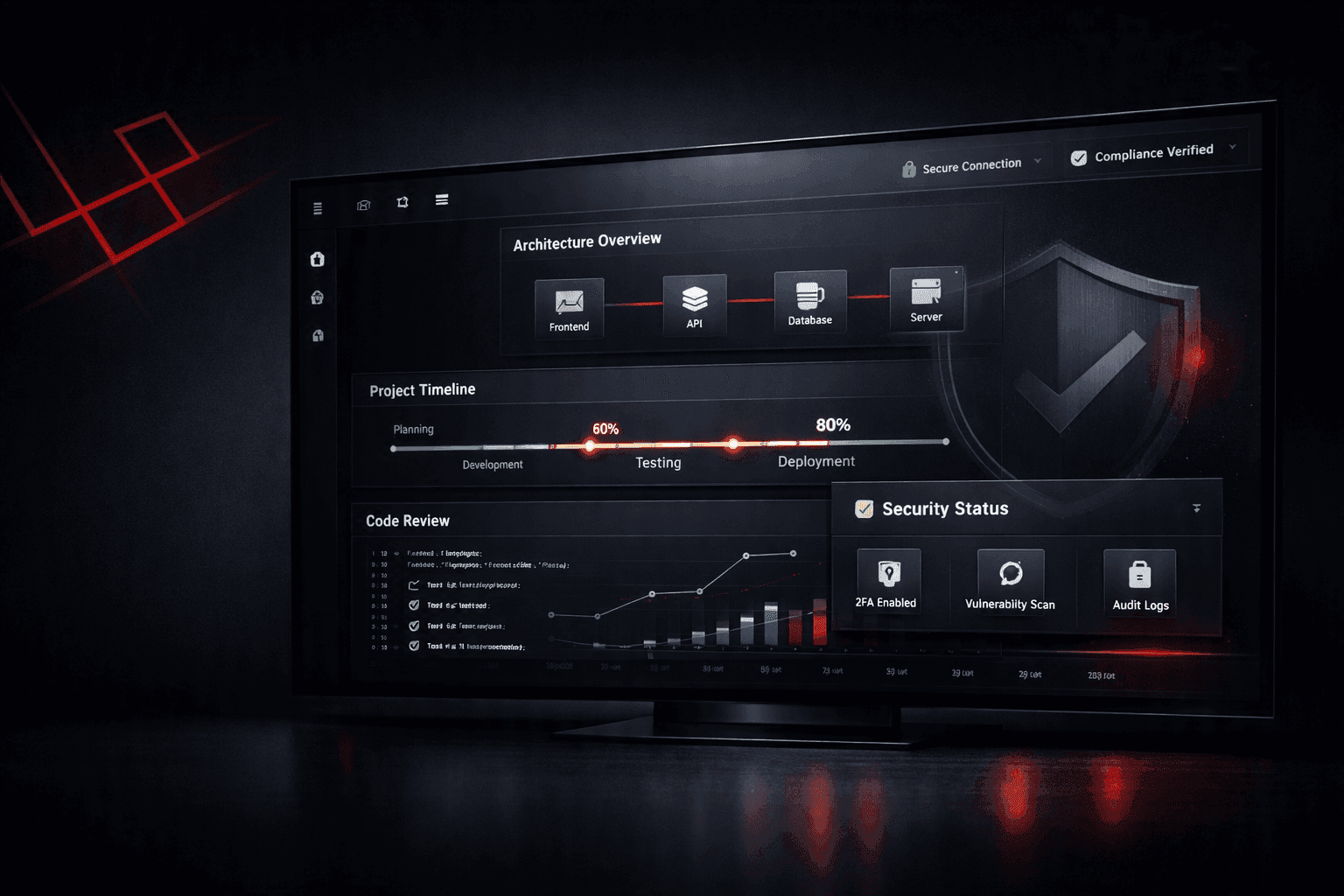
How a Laravel Consultant Keeps Projects Transparent
Clients don't just need a Laravel developer who can write code. They need confidence that their project is progressing, risks are being managed, and sensitive data is protected. Here's how I approach transparency, communication, documentation, and security when building Laravel applications.
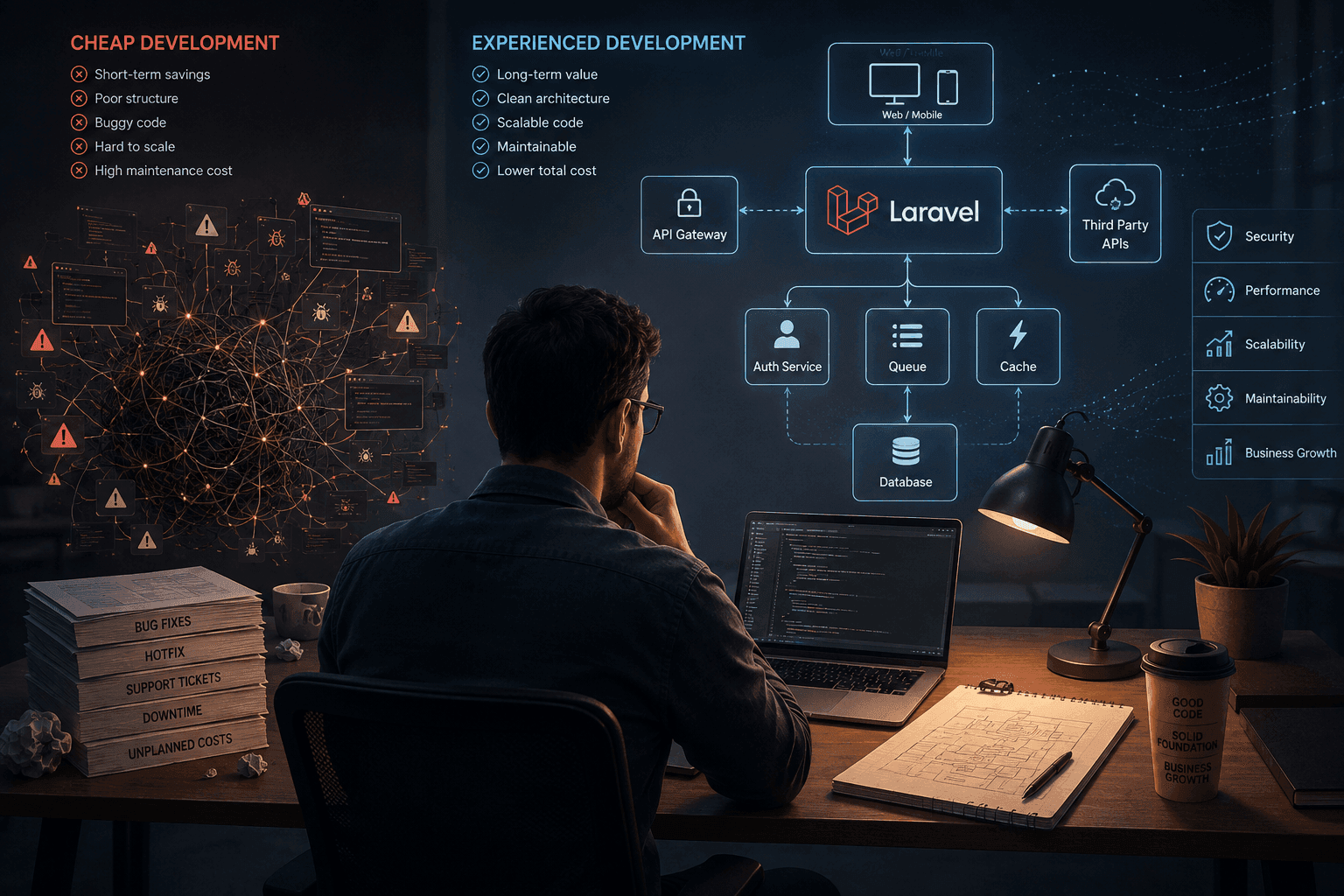
The Hidden Value of Senior Developers: Why Experience Beats Low-Cost Outsourcing
Hiring the cheapest developer can reduce your initial development cost, but it can also increase maintenance, technical debt, and long-term engineering costs. Here’s why experienced PHP and Laravel developers often deliver better value over the life of a product.

Scalable SaaS Architecture with Laravel & Next.js
Discover how to build high-performance, AI-integrated SaaS solutions. From mitigating LLM hallucinations to optimizing Laravel and Next.js performance, learn the architectural patterns that drive results.
Have a complex technical project in mind?
Available for full-stack engineering, performance audits, cloud deployments, and high-concurrency systems architecture.