

How a Laravel Consultant Ensures Project Transparency and Security#
When a business hires a Laravel consultant, it is trusting someone with more than its code. The developer may have access to customer data, infrastructure, business logic, APIs, and other critical systems.
That's why transparency and security should be part of the development process from day one.
A good development process should make the client feel informed, involved, and confident not left wondering what is happening behind the scenes.
1. Start With Clear Requirements#
Many project problems begin with unclear requirements.
Before writing code, I break requirements into clear functionality, user roles, workflows, integrations, and technical considerations.
Instead of simply asking "What do you want built?", I also look at:
- Who will use the feature?
- What should each user be allowed to do?
- What data is involved?
- What happens when something fails?
- What security requirements exist?
- How will the feature integrate with the rest of the system?
This creates a shared understanding before development begins.
Security requirements should also be considered early in the development lifecycle rather than added after the application is complete. OWASP recommends defining and managing security requirements as part of the development process.
2. Break Development Into Milestones#
Clients shouldn't have to wait until the end of a project to find out whether development is going in the right direction.
I prefer breaking larger projects into smaller milestones:
Requirements
    v
Architecture
    v
Development
    v
Testing
    v
Staging
    v
Production
Each milestone creates an opportunity to review progress, identify risks, and make decisions before they become expensive problems.
3. Communicate What Actually Changed#
Instead of simply saying:
"The dashboard is complete."
A useful update explains what was actually delivered:
- Dashboard connected to the database.
- Role-based permissions implemented.
- Error handling added.
- Mobile layout completed.
- Testing completed.
- Remaining work identified.
This gives the client a clear picture of progress without requiring them to understand every line of code.
4. Make Technical Decisions Understandable#
Clients don't need to understand every implementation detail, but important decisions should never feel like a black box.
For example, if an application needs caching, I explain why caching is needed, what problem it solves, and why a particular solution makes sense.
The same applies to:
- Database architecture
- APIs
- Authentication
- Authorization
- Queues
- Caching
- Third-party integrations
- Deployment
Good consulting means translating technical decisions into business impact.
5. Use Version Control#
Git provides an important layer of transparency and accountability.
A proper workflow allows the team to understand:
- What changed.
- When it changed.
- Why it changed.
- Which feature introduced a problem.
- What version is currently deployed.
A typical workflow is:
Feature
   v
Development
   v
Testing
   v
Staging
   v
Production
This is safer and more maintainable than making undocumented changes directly on a production server.
6. Keep Security in the Development Process#
Security shouldn't be a final checklist.
For Laravel applications, I consider areas such as:
- Authentication
- Authorization
- Input validation
- CSRF protection
- Rate limiting
- Secure file handling
- API authentication
- Sensitive configuration
- Error handling
- Logging
- Dependency management
- Secure deployment
Laravel already provides many security features that can be used instead of reinventing common security mechanisms. Its authentication system and encryption services are examples of functionality that can be incorporated into a properly designed application.
7. Authentication Isn't Authorization#
A user being logged in doesn't mean they should have access to everything.
For example:
Administrator
-> Manage users
-> Manage settings
-> Manage billing

Manager
-> Manage assigned resources
-> View reports

Customer
-> View own account
-> Manage own profile
Authentication answers "Who are you?"
Authorization answers "What are you allowed to do?"
This distinction is particularly important for SaaS platforms, CRMs, customer portals, and other multi-user applications.
8. Communicate Risks Early#
Good consultants don't hide problems.
If a third-party API has strict rate limits, poor reliability, or unexpected costs, the client should know before the architecture becomes dependent on it.
When I identify a risk, I prefer to communicate:
- What the problem is.
- What impact it could have.
- What options are available.
- What I recommend.
- Whether a decision is required.
Early communication is almost always cheaper than fixing surprises later.
9. Test Before Calling Something Done#
A feature isn't finished simply because it works on a developer's machine.
Depending on the project, testing may include:
- Unit testing
- Feature testing
- API testing
- Permission testing
- Integration testing
- Browser testing
- Regression testing
Security should also be considered throughout development and testing. OWASP recommends integrating security activities throughout the software development lifecycle.
10. Document What Matters#
Documentation doesn't need to be hundreds of pages.
For a Laravel application, useful documentation might cover:
- Project setup
- Environment configuration
- Database structure
- Deployment
- APIs
- Authentication
- Third-party integrations
- Scheduled jobs
- Queue workers
- Important architectural decisions
The goal is simple:
Another developer should be able to understand and maintain the system without depending entirely on the original developer.
Transparency Builds Trust#
Project transparency isn't about sending clients constant updates.
It's about giving them confidence that:
- Requirements are understood.
- Progress is visible.
- Technical decisions have a reason.
- Risks are communicated.
- Security is taken seriously.
- The application is tested.
- The project is properly documented.
That's the approach I try to bring to every Laravel project.
Because good software development isn't only about writing good code.
It's about giving the client confidence in the code, the process, and the person building it.
Share this technical insight with your network
Share to LinkedIn or Facebook with key takeaways, featured media, and direct links.
Case Study: Violerts - Enterprise NYC PropTech Compliance & Violation Monitoring SaaS
Violerts is a PropTech SaaS platform that consolidates fragmented NYC municipal property data into a single compliance intelligence platform. I led the modernization of the React frontend and Laravel backend, building multi-agency data ingestion, GIS mapping, asynchronous scraping, real-time alerts, team collaboration, and Stripe-powered SaaS billing.
Related Technical Articles
View all articles →
Scalable SaaS Architecture with Laravel & Next.js
Discover how to build high-performance, AI-integrated SaaS solutions. From mitigating LLM hallucinations to optimizing Laravel and Next.js performance, learn the architectural patterns that drive results.
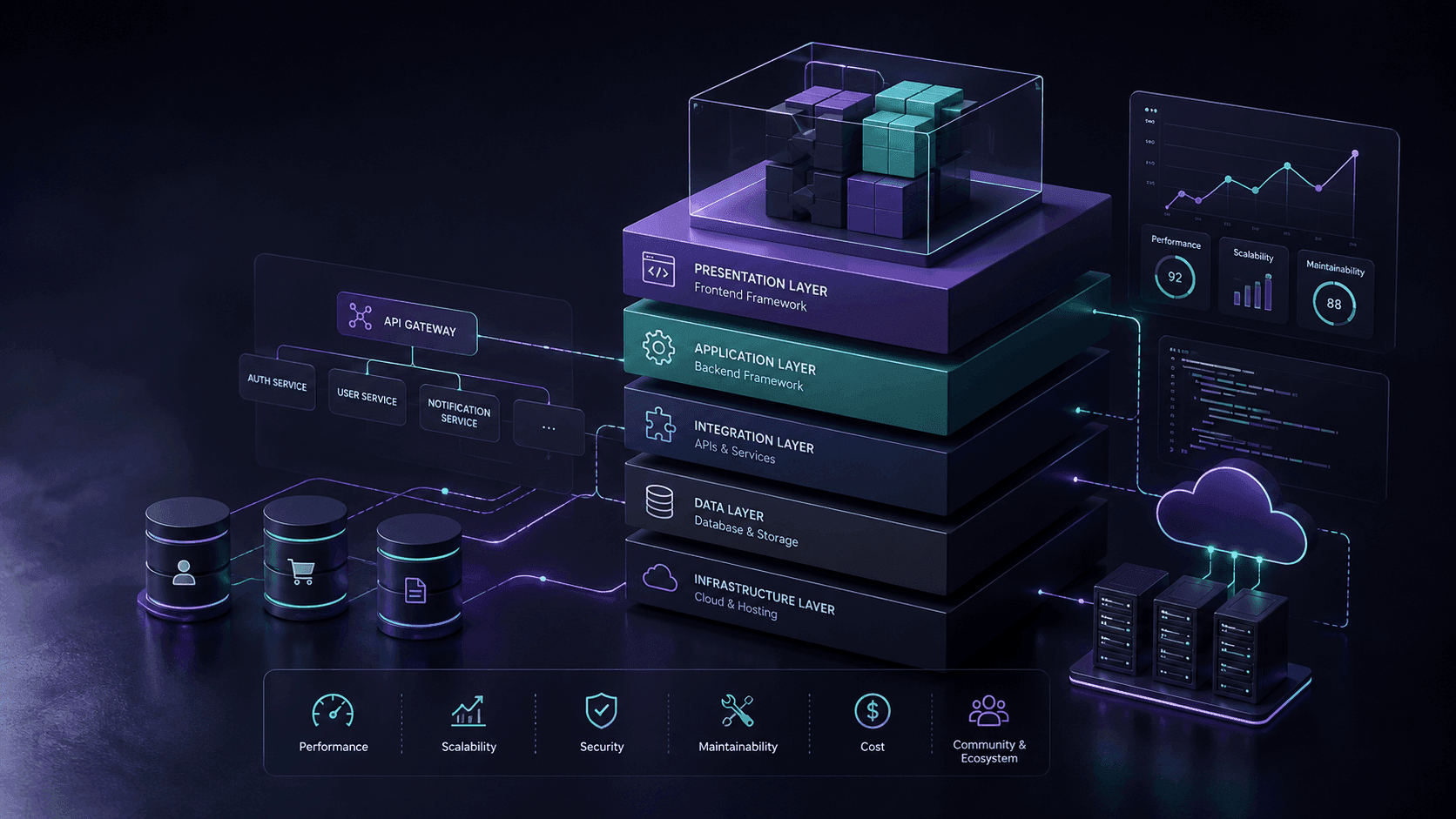
Choosing a Web Development Framework in 2026
Choosing the right web development framework can shape your application's performance, scalability, maintainability, and long-term cost. This guide compares modern frameworks and the factors that actually matter when selecting one for a real-world project.
Why PHP Still Matters in Modern Web Development
PHP has evolved far beyond its early reputation as a simple scripting language. Modern PHP powers scalable backend systems, ecommerce platforms, APIs, SaaS products, and frameworks like Laravel, making it a practical choice for today's web development landscape.
Have a complex technical project in mind?
Available for full-stack engineering, performance audits, cloud deployments, and high-concurrency systems architecture.