

If you need to hire a senior Laravel developer, the hardest part isn't finding candidates. It's telling a genuinely senior engineer apart from someone who has used Laravel for years but never owned a production system. Both write PHP, both list the same packages on their CV, and both interview well on framework trivia.
The difference shows up months later: in how the codebase holds up, how incidents are handled, and whether your product can still change quickly. A wrong hire at senior level is expensive because you're trusting that person with architecture decisions that are hard to undo.
This guide is the checklist I'd use if I were hiring a senior Laravel developer for a client: what "senior" actually means, what to check before an interview, questions that reveal real experience, a fair practical test, and the red flags to watch for.
What does "senior" mean for a Laravel developer?#
Years of experience are a weak signal on their own. A senior Laravel developer is someone who can be trusted with outcomes, not just tickets. In practice that means they can:
- Design, not just implement. They choose how data is modelled, where business logic lives, and how the system will grow, and they can explain the trade-offs.
- Run production. They have deployed, monitored, debugged and recovered real applications, not just built features locally.
- Work with the parts beyond Laravel. Queues, caching, databases, third-party APIs, hosting and security all matter as much as controllers and Blade.
- Reduce risk. They write tests where it counts, plan migrations safely, and flag problems before they become incidents.
- Communicate clearly. They can explain a technical decision to a founder in plain language and push back when a request will hurt the product.
If your project needs this level of ownership, it's worth reading how I approach Laravel and PHP development for clients, because the same standards apply to anyone you hire.
What to check before the first interview#
You can filter out a lot of mismatches before spending an hour on a call.
- Production work, described specifically. Look for projects where the candidate names the problem, their role and the result: "built a queue-based import that processes CSV files with retries" says far more than "worked on a Laravel app".
- Breadth around the framework. A senior profile mentions queues, Redis, database tuning, API integrations, deployment or CI/CD, not just Laravel features.
- Code you can read. Public repositories, packages, or a code sample from past work (with confidential parts removed) tell you more than any CV.
- Writing quality. Clear, structured messages during the first exchange are a good predictor of clear documentation and pull requests later.
- Current versions. Ask which Laravel and PHP versions they've worked with recently. Senior developers keep up with the Laravel upgrade path and modern PHP releases.
Interview questions that reveal real experience#
Skip trivia like "what is a service provider?". Anyone can memorise that. Ask questions that only someone who has run production systems can answer well:
| Question | What a strong answer includes |
|---|---|
| "Tell me about a production incident you handled." | What broke, how they found the cause, how they fixed it, and what they changed so it didn't happen again. |
| "How would you process 50,000 rows from an uploaded CSV?" | Queued jobs, chunking, validation per row, retries, idempotency and progress feedback for the user. |
| "Where do you put business logic in a Laravel app, and why?" | A clear, reasoned structure (services, actions or domain classes), not "it depends" with no follow-up. |
| "A page got slow after launch. What do you check first?" | Query counts and N+1 problems, indexes, caching, queue backlog and real measurements before guessing. |
| "How do you deploy without downtime?" | Migrations that are safe to run on a live app, build steps, queue restarts and a rollback plan. |
| "How do you integrate an unreliable third-party API?" | Timeouts, retries with backoff, logging, webhooks verified with signatures, and handling partial failures. |
Listen for specifics. Senior developers naturally mention trade-offs, things that went wrong, and what they would do differently.
How to run a fair practical test#
A short, paid, realistic task beats a long unpaid one or a whiteboard puzzle. A good format:
- Scope it to 2–4 hours. For example: "Add an endpoint that imports orders from a CSV, validates them, processes them in the background and reports failures."
- Use your real context where possible, with a small sanitised slice of your domain.
- Review it together. A 30-minute walkthrough of their code shows how they reason, accept feedback and explain decisions.
What to look for in the result:
- Sensible structure and naming, with business logic outside controllers
- Validation and error handling, not just the happy path
- A few meaningful tests rather than none or dozens of trivial ones
- Use of queues where work shouldn't block a request
- A short README explaining assumptions and what they'd do with more time
Red flags when hiring a Laravel developer#
Some warning signs come up again and again:
- Every answer is a package name. Packages are useful, but a senior developer can explain what a package does and when not to use it.
- No production stories. If they can't describe an incident, a slow query they fixed or a deployment that went wrong, they probably haven't owned production.
- "We never write tests." Not every project needs full coverage, but a senior developer should know where tests protect the business.
- Vague estimates with no questions. Good estimates come with questions about scope, integrations and data.
- Defensiveness in code review. Strong engineers welcome questions about their decisions.
Price alone is also a risk. I've written about why experienced developers usually cost less over a product's life than the cheapest option.
Example: what senior work looks like in practice#
Two projects show the kind of work you're really hiring for.
On the Jamaica freight-forwarding platform audit, I was brought in to audit and stabilise a nearly completed platform built with Core PHP and MySQL before any further development. The work was about understanding the system first: auditing operational workflows, reviewing the database structure, mapping dependencies, evaluating configuration and environment governance, and assessing the path to a future Laravel migration. A senior developer should be comfortable starting a project this way, not just writing new features on top of an unknown codebase.
On the multi-carrier bulk SIM activation platform, I built a CSV-driven activation engine inside an existing Laravel dealer platform. It validates multi-tier dealer funds, routes each row to the correct carrier API, processes activations asynchronously with retries, and streams live progress back to the dealer. That combination of queues, retries, third-party APIs and real-time feedback is exactly what the CSV interview question above is testing for.
Freelancer, agency or in-house?#
The checklist works for all three, but the trade-offs differ:
- Senior freelancer: fast to start and flexible, and you work directly with the person writing the code. Best for focused projects, rescues and audits.
- Agency: more capacity and continuity, but check who actually does the work and whether a senior developer reviews it.
- In-house hire: best for long-term ownership of a core product, but slower to hire and a bigger commitment.
Many startups start with a senior freelancer to build or stabilise the first version, then hire in-house once the product and its architecture are clear.
Frequently asked questions#
How much does a senior Laravel developer cost?#
Rates vary widely by region, experience and engagement type. Compare total cost for the outcome you need, including time to deliver and the maintenance burden left behind, rather than hourly rate alone.
How long should hiring a senior Laravel developer take?#
With a clear brief, a short screening call, one technical interview and a paid practical task, most teams can decide within one to three weeks.
Should a senior Laravel developer also know frontend?#
It depends on your stack. Many senior Laravel developers work comfortably with Vue, React or Livewire. If your product is frontend-heavy, check that experience explicitly in the practical task.
What's the best first task for a new Laravel developer?#
A small, real improvement with clear value, such as fixing a known slow page or adding tests around a fragile feature. It shows how they navigate your codebase and communicate.
Key takeaways#
- Senior means ownership of outcomes: design, production, risk and communication, not just years with Laravel.
- Filter early with specific production work, breadth beyond the framework and readable code.
- Ask about incidents, imports, performance, deployments and integrations rather than framework trivia.
- Use a short, paid, realistic task and review it together.
- Watch for package-only answers, no production stories and no questions behind estimates.
If you need a senior Laravel developer for a build, rescue or audit, book a call and we can talk through your project.
Share this technical insight with your network
Share to LinkedIn or Facebook with key takeaways, featured media, and direct links.
Case Study: PPCWA: Jamaica Freight Forwarding Audit
I was brought in to audit and stabilize a nearly completed freight-forwarding platform built with custom Core PHP and MySQL. The platform manages the journey from international online purchases and overseas warehouse receiving through pre-alerts, package tracking, customs handling, and local delivery. My work focused on understanding the existing system before further development: auditing operational workflows, reviewing the database structure, assessing frontend maintainability, mapping dependencies, and evaluating configuration and environment governance. I also assessed the architectural path toward a future Laravel migration.
Related Technical Articles
View all articles →
The Hidden Value of Senior Developers: Why Experience Beats Low-Cost Outsourcing
Hiring the cheapest developer can reduce your initial development cost, but it can also increase maintenance, technical debt, and long-term engineering costs. Here’s why experienced PHP and Laravel developers often deliver better value over the life of a product.
How a Laravel Consultant Keeps Projects Transparent
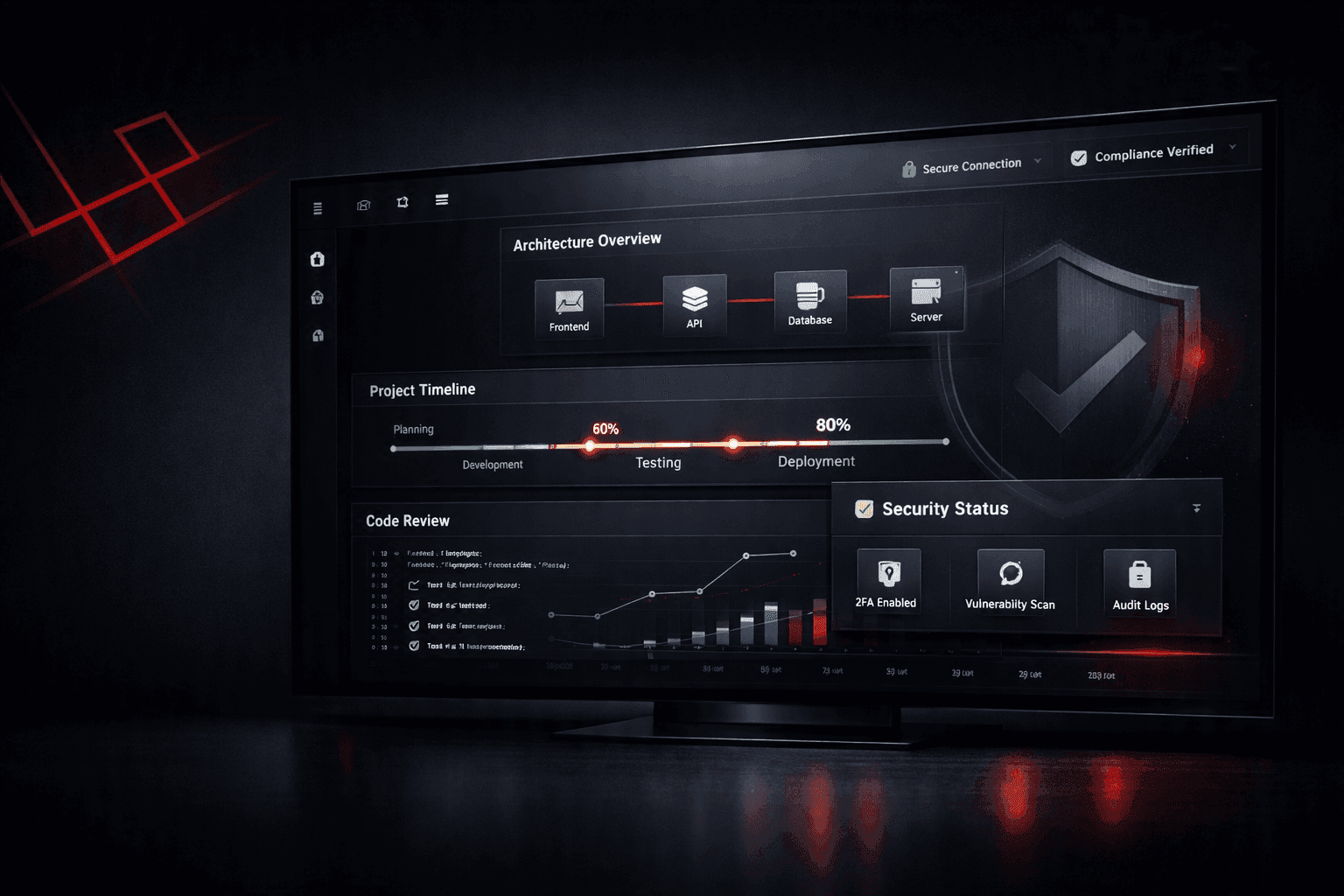
Clients don't just need a Laravel developer who can write code. They need confidence that their project is progressing, risks are being managed, and sensitive data is protected. Here's how I approach transparency, communication, documentation, and security when building Laravel applications.
Laravel vs Node.js for SaaS: How to Choose the Right Backend
A practical comparison of Laravel and Node.js for building a SaaS backend: time to launch, built-in features, real-time needs, hiring, hosting and maintenance, with examples from real SaaS products built on each.
Laravel Queue Architecture: Jobs That Survive Production
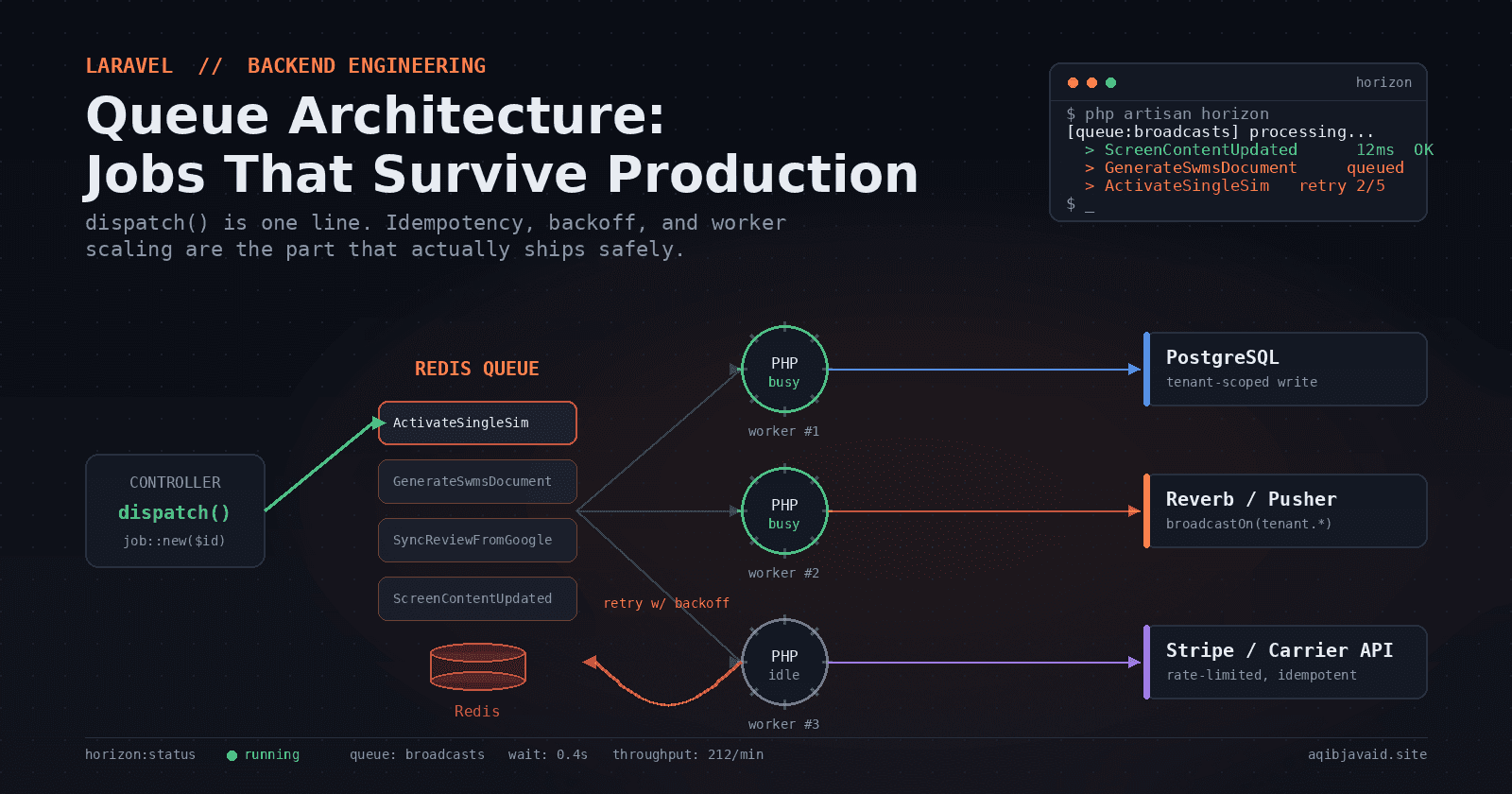
dispatch() is one line. Making that job safe to retry, cheap to scale, and impossible to double-run is the actual engineering problem.
Have a complex technical project in mind?
Available for full-stack engineering, performance audits, cloud deployments, and high-concurrency systems architecture.